Ancient Corfu
Corfu, one of the most historic islands of the Ionian Sea, has been since antiquity a hub of trade, culture, and strategic significance. Known in ancient times as Korkyra, ancient Corfu played a vital role in the political and military history of Greece while simultaneously serving as a cradle of mythological narratives, artistic expression, and naval supremacy.
Its strategic geographical location, at the entrance of the Adriatic Sea and between mainland Greece and Italy, made Corfu a valuable stopover for commercial and military expeditions. The first traces of human presence on the island date back to the Neolithic period, with organized settlements appearing during the Bronze Age. The island’s crucial position soon attracted the attention of powerful city-states of ancient Greece, leading to the establishment of a colony by Corinth in the 8th century BCE. The founding of Korkyra around 734 BCE by Corinthian settlers marked the beginning of its development as an ancient city-state. According to the historian Thucydides, the colonization was led by Chersicrates, a Heraclid and member of the royal Bacchiad dynasty.
Naval Power, Mythological Legacy, and Cultural Crossroads Between Greece and the West in the Political and Artistic Landscape of the Classical World
The growth to tourism
The relationship between Korkyra and its metropolis, Corinth, was strained almost from the start, eventually leading to military confrontations. Despite this, Korkyra rapidly rose to prominence as a naval power, with a formidable fleet and commercial activity across the Mediterranean. Thucydides noted that before the outbreak of the Peloponnesian War, Korkyra had one of the largest fleets in Greece, emphasizing its naval dominance and military preparedness.
Ancient Corfu is also deeply embedded in Greek mythology, which lends the island a symbolic and cultural weight that has endured for centuries. The name "Korkyra" is derived from the nymph Korkyra, daughter of the river god Asopos. According to legend, the god Poseidon fell in love with the nymph, abducted her, and brought her to the island, naming it after her. From their union was born Phaeax, whose descendants became the legendary Phaeacians, known in myth for their hospitality and seafaring excellence.
Homer’s Odyssey presents Corfu as the last stop of Odysseus before his long-awaited return to Ithaca. The royal family of the Phaeacians, King Alcinous, Queen Arete, and Princess Nausicaa, are portrayed as paragons of hospitality and refinement, offering Odysseus protection and passage home. These stories highlight Corfu’s mythological legacy and its connection with the idealized values of ancient Greek civilization.
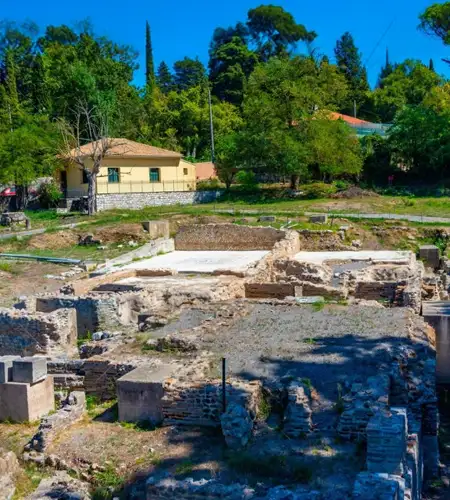
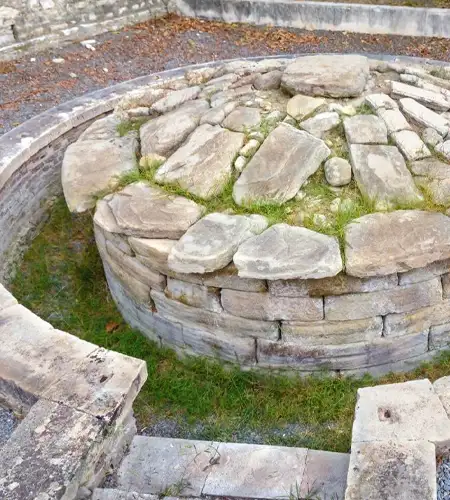
Organized as a polis (city-state), ancient Korkyra developed its own political structures, currency, and institutions. However, like many other Greek cities, it experienced internal strife, particularly between aristocratic and democratic factions. The bloodiest civil conflict occurred in 427 BCE during the Peloponnesian War, when the democrats, supported by Athens, seized control after brutal battles and mass executions. This episode, described by Thucydides in detail, became a symbol of the destructive potential of internal division.
The island of the Phaeacians enjoyed a robust economy based on maritime trade, shipbuilding, and agriculture. It had an extensive trade network that stretched to the shores of Italy, Sicily, and the Greek colonies along the Adriatic Sea. Culturally, it was equally vibrant. Korkyra boasted a theater, temples, sanctuaries, and public buildings. One of its most remarkable monuments is the Temple of Artemis Gorgo, known for its sculpted pediment depicting the Gorgon Medusa (circa 590–580 BCE). This is one of the earliest surviving examples of large-scale stone sculpture in the Greek world and is now housed in the Archaeological Museum of Corfu.
Corfu was also among the first Greek cities to mint its own coins, as early as the 6th century BCE. These coins depicted mythological and symbolic figures such as Medusa, Poseidon, and the Phaeacians, reflecting both the island’s mythological heritage and political identity. Corfiot art blended Doric and Ionic styles and was influenced by Western artistic trends, especially through trade with Magna Graecia (Southern Italy). Its artistic achievements include noteworthy works in architecture, pottery, and sculpture.
After the 3rd century BCE, Corfu followed the trajectory of most Greek cities. It was conquered by the Romans in 229 BCE, during Rome’s intervention in Greek affairs against the Illyrians. Though it maintained limited autonomy, Corfu was gradually integrated into the Roman sphere, with its harbor used as a naval base. While its political importance declined, the island continued to be inhabited and retained a cultural character throughout the Roman and Byzantine periods.
Ancient Corfu was a powerful naval city-state with political independence, a thriving cultural life, and active participation in the events of the ancient Greek world. It merged mythological brilliance with political authority and maritime superiority, leaving a lasting imprint on both history and legend. Even today, remnants of its ancient walls, temples, and artistic works serve as enduring testaments to a glorious past that shaped Corfu’s identity as a cultural bridge between Greece and the West.