Gastouri and Achilleion
Nestled among the lush hills of central Corfu and just 10 kilometers from the island’s main town, the village of Gastouri radiates tradition, nobility, and authentic Ionian charm. At its heart lies one of the most renowned landmarks not only of Corfu but of all Greece: the Achilleion Palace, a masterpiece built by Empress Elisabeth of Austria known more commonly as Sisi and later owned by the German Kaiser.
Gastouri is one of the oldest villages on the island. While the first documented mention appears in Venetian records from the 16th century, its history likely stretches further back in time. According to local scholars, the village's name may derive from the Greek word gaster or gastir, referring either to the bowl-like shape of the surrounding land or to its fertile soil that "nourishes" its people like a mother.
A Serene Corfu Village Home to the Majestic Achilleion Palace, Rich in Tradition, History, and Natural Beauty, Offering a Glimpse into Greece's Imperial Past
A village lost in time
Today, Gastouri has preserved its traditional character. Narrow alleys (kantounia), old mansions, small village squares, and Byzantine churches compose a serene and atmospheric setting. The village is surrounded by hills covered in olive trees, cypress, and lemon groves, filling the air with the scents of another era. This tranquil ambiance, combined with the area’s natural beauty, draws travelers seeking the “real” Corfu far from the bustle of mass tourism. The locals are warm and welcoming, continuing to practice the customs that have shaped village life for centuries. Visitors may hear the Corfiot dialect, witness a local festival (panigyri), or taste homemade dishes made from time-honored recipes.
The crown jewel of Gastouri and indeed one of Corfu’s greatest landmarks is without a doubt the Achilleion Palace. Built in 1890 at the behest of Empress Elisabeth of Austria, the palace was born from her deep love for Corfu’s landscape and her admiration for the mythological hero Achilles. After enduring personal tragedies and growing weary of the rigid life at the Viennese court, Sisi sought peace and solace on the island, which she viewed as a personal paradise.
The palace is constructed in the neoclassical style, influenced by both ancient Greek and Italian Renaissance architecture. Its name, Achilleion, honors Sisi’s beloved hero Achilles, an emblem of bravery, physical perfection, and a pure heart. Inside, the palace is adorned with paintings, sculptures, and decorative elements that depict Achilles in various stages of his life and heroic exploits. The most famous of these is The Triumph of Achilles, a dramatic painting by Franz Matsch that dominates the palace’s grand staircase.
After Sisi’s assassination in 1898, the palace passed into the hands of Kaiser Wilhelm II of Germany. He used it as a summer residence and made several additions to the building’s exterior and gardens. During both World Wars, the palace was used as a military hospital, and in later years it served variously as a casino and a museum open to the public.
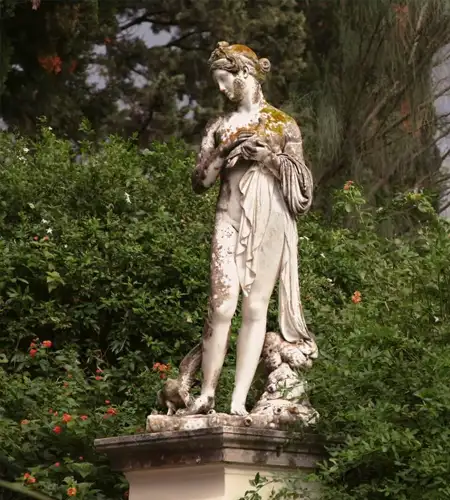
The gardens of the Achilleion are a true work of art. Sprawling across terraced slopes that offer breathtaking views of the Ionian Sea, the grounds are dotted with marble busts of ancient philosophers like Socrates and Plato. Among the most notable sculptures is The Dying Achilles, created by German sculptor Ernst Herter. It captures the hero of the Iliad in his final moments, wounded and noble, exuding a tragic grandeur. The statue is widely regarded as one of the most beautiful sculptures in Greece.
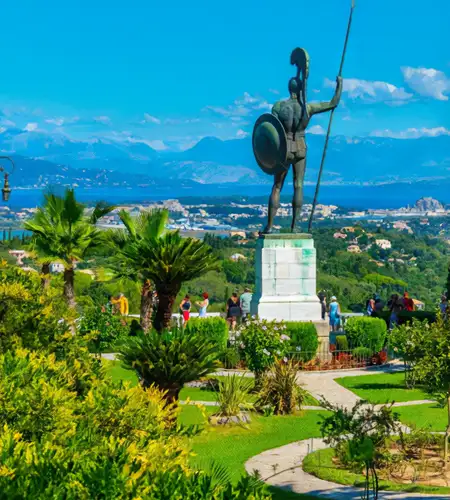
Later, the Kaiser added a contrasting statue known as Achilles Victor, showing the hero upright, proud, and triumphant, with a spear in hand and a determined expression. The contrast between the two sculptures reflects the differing philosophies of their commissioners: Sisi sought inner peace and tragic beauty, while the Kaiser emphasized power, glory, and imperial strength.
Today, the Achilleion Palace functions as a museum and draws thousands of visitors annually. Admission includes a tour of the interior rooms, the gardens, and multimedia presentations about the lives of Sisi, the Kaiser, and the palace itself. The interior features authentic period furnishings, clothing, and personal belongings of the Empress, while also offering a glimpse into the cultural and social life of Corfu during the late 19th and early 20th centuries.
The view from the palace’s balcony is truly magical, especially at sunset. From this vantage point, one can see as far as Pontikonisi (Mouse Island), the Garitsa Bay, and the endless horizon of the Ionian Sea. It is a place where history and nature meet in rare harmony.
Even today, the village of Gastouri benefits from the presence of the Achilleion, but it has never transformed into a full-blown tourist resort an element that adds to its charm. Instead, visitors can still find small tavernas serving homemade food, peaceful nature walks, and traditional homes offering heartfelt hospitality.