Corfu Old Town
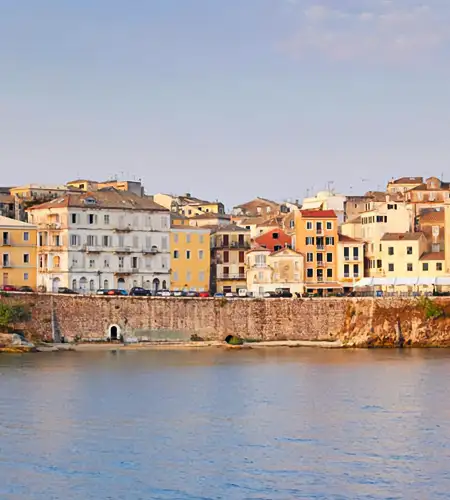
The Old Town of Corfu is a living monument of culture, history, and aesthetic charm, rightfully listed among the UNESCO World Heritage Sites. Strongly marked by Venetian, French, and British influences, the Old Town is a unique mosaic of traditions and cultures, which has retained its charm and authenticity to this day. Visitors who wander through its narrow cobblestone alleys, the famous kantounia, have the rare opportunity to experience Corfu as it was lived by its residents centuries ago, in an atmosphere filled with nostalgia, warmth, and romance.
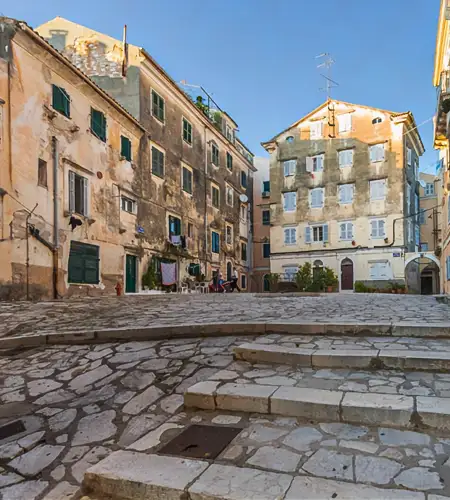
The kantounia are among the most characteristic and perhaps the most emblematic elements of the town. These narrow, stone-paved alleys form a labyrinth between tall, tightly packed buildings that preserve the Venetian aura of the past. The façades of the houses are often adorned with wooden shutters, wrought-iron balconies, and laundry drying on lines stretched from window to window images that compose the everyday life of the locals and offer a timeless sense of continuity. Walking through these alleys, one feels immersed in an authentic Mediterranean setting, where history and modern life blend effortlessly.
Venetian Alleys, British Palaces, French Elegance, and Living History in a Timeless UNESCO Heritage Site of Culture, Charm, and Mediterranean Spirit
An extraordinary maze
The urban layout of the Old Town reflects both the defensive needs of its residents during the Venetian period and the influence of Italian architecture. The tall, multi-story buildings and narrow passageways were designed to provide cool shade in the summer heat, while also forming a tightly knit neighborhood full of life, voices, and scents. The layout also had a strategic role, aiming to improve the town’s defenses in the event of an invasion. The color palette of the Old Town includes earthy tones: hues of ochre, brown, red, and green harmonize with the stone structures and the flowers that bloom on every balcony and corner. The result is a welcoming yet mysterious setting, where every step uncovers a new story.
One of the most impressive and historically significant buildings in the Old Town is the Palace of St. Michael and St. George, also known as the Old Palace. Located on the eastern edge of Spianada Square, it is one of the few examples of neoclassical British architecture in Greece. The palace was built by the British in the early 19th century and served as the residence of the British High Commissioner during the period of British rule over the Ionian Islands. Its imposing symmetrical façade, Doric columns, and grand colonnade reflect the power and formality of that era. Today, the building houses the Museum of Asian Art, a unique institution of its kind in Greece, which regularly hosts exhibitions, cultural events, and official receptions. The Palace combines European refinement with Greek tradition, and the fact that it remains in such excellent condition shows the respect Corfiots have for their historical heritage.
Adjacent to the Palace lies the Spianada, the central square of Corfu, which is not only the heart of the island’s social life but also the largest square in the Balkans. Its name derives from the Italian word spianata, meaning "flat space," and that’s exactly what it is: a vast open area filled with greenery, perfect for walks, children’s play, and families enjoying the sun. The square hosts a wide array of events, from musical concerts to parades and traditional festivities, such as the famous Easter celebrations with the botides the traditional clay pots thrown from balconies to shatter in the streets below. One of the most unique aspects of the Spianada is that cricket, a rare remnant of British heritage in Greece, is still played on its lawn, enhancing the district's distinctive identity.
On the western side of this exceptional square stands the famous Liston, one of the most elegant and picturesque areas of Corfu. Built by the French in the early 19th century and modeled after the Rue de Rivoli in Paris, the Liston is characterized by its arches, known locally as volta. These arcades exude a timeless French elegance. In the past, Liston was a place of social prestige only those whose names appeared on the "list" of nobility were permitted to stroll there, which is how it got its name. Today, it is a vibrant hub full of cafes and restaurants, where locals and tourists alike sip coffee under the arcades and watch the rhythm of the town unfold before them.