Old and New Fortress
Corfu carries a rich and turbulent history, one that is vividly reflected in its two iconic fortresses: the Old Fortress and the New Fortress. These strongholds are not merely monuments of military architecture; they stand as enduring symbols of culture, resilience, and political identity. For centuries, they helped shape both the image and destiny of the island. Each corner of these fortifications holds a tale, a battle, a struggle for freedom. Once defensive bastions of vital military importance, today they have transformed into cultural landmarks, spaces of social life and collective memory.
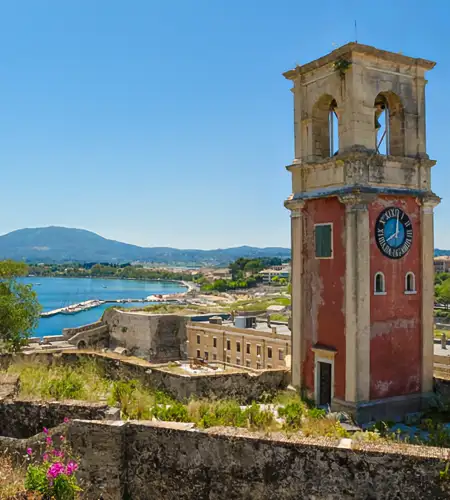
The Old Fortress is situated at the eastern edge of the Old Town of Corfu, atop a promontory that was artificially turned into an island with the creation of the Contrafossa, a wide moat that enhanced its defensive capabilities. Its origins date back to the Byzantine era, with significant reinforcements occurring in the 8th century. However, the form it takes today is primarily the result of Venetian engineering and fortification works that spanned from the 15th to the 18th century. Recognizing the island’s strategic significance, the Venetians invested heavily in the defense of the Old Fortress. They developed a robust system of fortifications, including ramparts, artillery placements, and bastions, effectively rendering the fortress nearly impregnable.
The Old and New Fortresses as Symbols of Defense, Heritage, Cultural Identity, and Enduring Memory in the Island’s Historic and Modern Landscape
The growth to tourism
A notable feature of the Old Fortress is its double bastion system, underground tunnels, ammunition depots, and the Church of Saint George, designed in the style of an ancient Doric temple a blend of religious and military functionality rarely seen. This architectural complex is of exceptional historical and aesthetic value, a testament to the fusion of necessity and beauty.
Throughout the Venetian period, the Old Fortress served as both the military and administrative hub of Corfu. Later, during the British Protectorate in the 19th century, it was again repurposed, with the addition of new buildings and structures. The fortress notably withstood multiple sieges, including the significant Turkish siege of 1716, a defense that not only preserved the island from Ottoman control but also elevated Corfu’s status as one of the most secure cities in Europe at the time.
On the opposite side of the city lies the New Fortress, also known as the Fortress of Saint Mark. It was constructed by the Venetians between 1576 and 1588, during a period of increased pressure and after recognizing that the growing density of the Old Town made defense from a single stronghold insufficient. The New Fortress is located on Saint Mark’s Hill, just behind the old harbor, commanding both the city’s interior and the sea approaches. Unlike the more visible and grand Old Fortress, the New Fortress is lower in profile, more compact, and based on more modern defensive strategies designed to absorb cannon fire rather than deflect it.
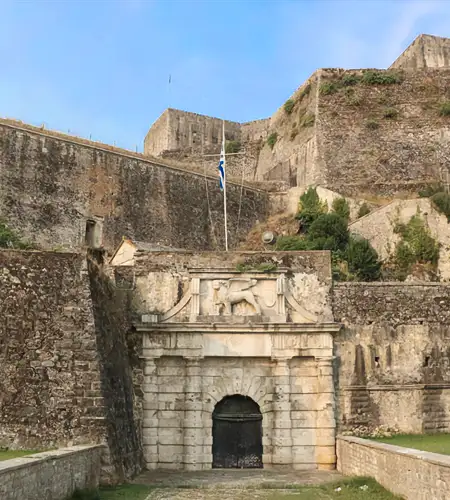
The fortress is characterized by dense bastions and complex subterranean tunnels that still connect parts of it to the Old Town. Inside, one can find expansive storage rooms, barracks, and underground passageways that remain largely unexplored by the public to this day. Like its older counterpart, the New Fortress was also used extensively by the British during their rule, who expanded and modernized several of its facilities. In the modern era, the New Fortress is partially under the control of the Hellenic Navy. However, large sections are accessible to visitors and frequently serve as venues for exhibitions, cultural events, and art installations.
Beyond their military roles, these two fortresses have had a profound impact on the identity and social fabric of Corfu. They served as both physical and symbolic boundaries separating the world of everyday life from that of command, discipline, and defense. Their presence fostered a sense of security and stability, enabling Corfiot society to flourish intellectually, economically, and artistically. Their success in withstanding Ottoman and other assaults gave Corfu a rare advantage: the chance to grow into a cosmopolitan, European center of culture an identity that endures to this day.
For the people of Corfu, the fortresses were always more than just stone walls. They were points of orientation, places of memory, pride, and tradition. Whether for practical protection or as symbols of historical triumph, the fortresses were constant elements in local stories, songs, and customs.