The British Footprint in Corfu: Architecture, Cricket and Tea
When strolling through Corfu, it is easy to feel the presence of many cultures that have shaped the island. Among them, the British influence holds a unique and elegant position. Though the British ruled Corfu for only a few decades in the 19th century, their legacy remains visible in architecture, customs and even in the gentle clink of teacups on shaded verandas.
A Brief Chapter with a Lasting Mark
The British arrived in Corfu in 1815, following the Napoleonic Wars. The Ionian Islands became a British Protectorate under the name United States of the Ionian Islands. This lasted until 1864 when the islands were peacefully united with Greece. Despite the short duration, this era brought significant changes in public administration, infrastructure and urban planning.
The British period was not marked by military conquest but by structured governance and development. Their goal was to modernize the Ionian Islands and to transform Corfu into a symbol of stability and order.
Architectural Legacy of Elegance and Function
One of the most visible imprints of British rule is in Corfu’s architecture. The Palace of Saint Michael and Saint George stands as a proud testament. Built between 1819 and 1824 by British Commissioner Sir Thomas Maitland, it is one of the most striking neoclassical buildings in Greece.
The palace was originally designed to house the High Commissioner and the Ionian Senate. Today, it hosts the Museum of Asian Art, but the grandeur of its Doric columns, symmetrical wings and expansive arcades still echo British design sensibilities.
Elsewhere in Corfu Town, you will find elegant colonial style buildings, refined townhouses and British-style street planning. Even the gardens of Mon Repos Palace, a summer residence gifted to Prince Philip’s family, reflect a Victorian aesthetic.
The Unexpected Sport of Cricket
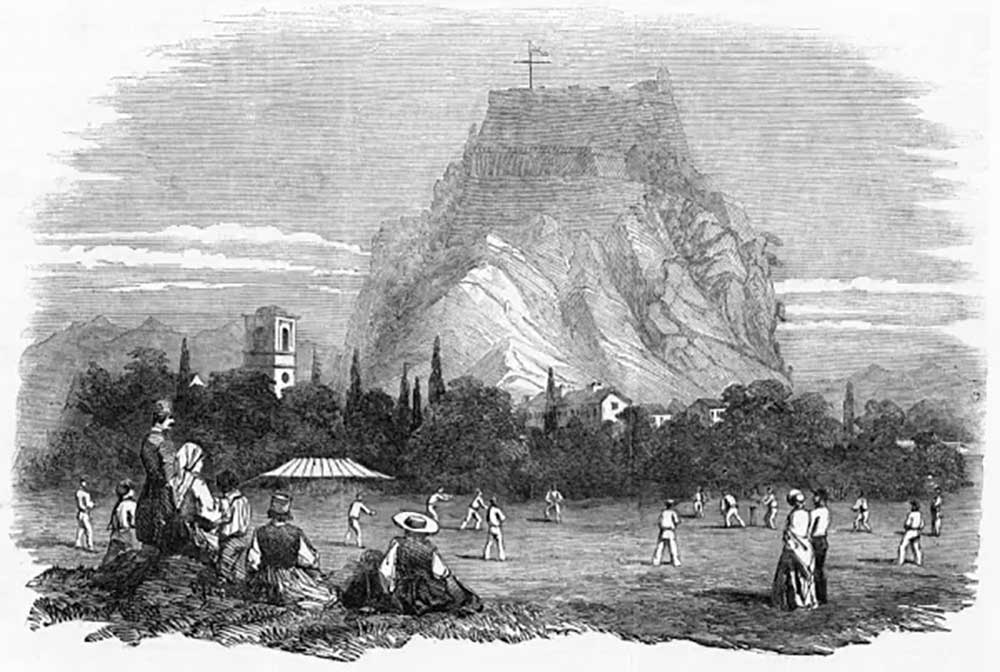
Cricket might not be the first thing that comes to mind when thinking of Greek islands, but Corfu is a rare exception. The British introduced the sport during their occupation and it quickly caught on. Unlike other places in Greece, Corfu embraced cricket and made it its own.
To this day, cricket is played on the Spianada, the grand esplanade at the heart of Corfu Town. It is the only place in Greece where the sport is still practiced regularly and competitively. Local teams, including children and adults, keep the tradition alive, often playing under the watchful eyes of curious tourists.
The Corfu Cricket Club has even hosted international matches, welcoming players from the UK and beyond. The image of cricketers in white uniforms playing against the backdrop of Venetian fortresses and neoclassical buildings is a surreal blend of cultures.
Civil Improvements and Infrastructure
The British were efficient administrators. They improved road networks, established a postal service and invested in public works. Drainage systems were modernized, and many public health initiatives were introduced. Their influence extended beyond Corfu Town into the countryside, where agricultural practices also saw changes.
One of the most important developments was the founding of the Ionian Academy. It became the first modern university in Greece and reflected the British commitment to education and intellectual progress.
A Taste of Tea and British Manners
Another layer of British culture that lingered on the island is the tradition of afternoon tea. While not widespread, it remains a symbol of refinement in some Corfiot households. Teahouses in Corfu Town serve blends that nod to British tastes, often accompanied by biscuits or small pastries.
The British brought with them a sense of formality, etiquette and reserved elegance. Though Mediterranean warmth often overrides British reserve, there remains a subtle sense of order and quiet dignity in many Corfiot homes and institutions that reflects this past influence.
Mon Repos and the Royal Ties
Mon Repos Palace is not just a beautiful summer villa. It is also the birthplace of Prince Philip, Duke of Edinburgh. Though he left Greece as an infant, his birth connected the British monarchy with the Ionian Islands in a way that still fascinates history lovers.
The villa sits in a serene park filled with old trees, fountains and paths. It reflects British landscaping ideals, focusing on harmony and natural elegance. Today, visitors can walk through its halls and gardens, exploring exhibitions and enjoying panoramic views of the sea.
A Lasting Cultural Connection
Even after the British left, Corfu maintained a strong connection with the United Kingdom. Many Corfiots studied in British universities, and the English language remains widely spoken. British tourists have been visiting the island for decades, often returning year after year, creating a familiar bond between two cultures.
In some ways, the British did not just leave behind buildings or systems. They left behind a certain way of seeing the world practical, elegant, and quietly proud.
A Walk Through History
Exploring Corfu with an eye for its British past adds a new dimension to your visit. From neoclassical façades to the sound of leather against willow on a summer afternoon cricket match, these echoes of the 19th century still speak to us today.