The religious history of Corfu is deeply intertwined with Saint Spyridon, the island’s patron saint, whose presence and miracles have left an indelible mark on the local community. Corfu’s religious identity was shaped through a series of historical periods and foreign dominations, each influencing the island’s spiritual and cultural landscape in unique ways.
During the Venetian rule from 1386 to 1797, Corfu was under the dominion of Venice, a period that brought significant changes to the island’s religious life. The Catholic Church sought to impose its influence, which led to tensions and conflicts with the Orthodox Church and its faithful followers. Despite these pressures, Orthodoxy remained deeply rooted in Corfiot society. The island’s inhabitants steadfastly preserved their traditions and customs, maintaining their spiritual heritage even in the face of foreign religious dominance.
Following the Venetian period, the British Protectorate era (1815–1864) introduced new influences but again the Orthodox Church retained its central role in the social and spiritual life of Corfu. The union of Corfu with the modern Greek state in 1864 further strengthened the Orthodox identity of the island, aligning it more closely with the national religious tradition of Greece.
Saint Spyridon himself was born in 270 A.D. on the island of Cyprus and served as the Bishop of Trimythous. He notably participated in the First Ecumenical Council in 325 A.D. Renowned for his humble life and numerous miracles attributed to him, Saint Spyridon is one of the most revered figures in Orthodox Christianity. His relics were brought to Corfu in the 15th century, at a time when Cyprus was threatened by the advancing Ottoman Empire. Since then, Saint Spyridon has been considered the protector of the island, with countless miracles credited to him, including the saving of Corfu from epidemics and sieges.
The Church of Saint Spyridon, built in 1589, is located in the heart of Corfu’s old town. It is a single-nave basilica distinguished by its impressive interior decoration, which includes a marble iconostasis and artworks by the local painter Spiros Prosalentis. Its bell tower, standing 40 meters tall, is the tallest in the Ionian Islands and a distinctive landmark of the city.
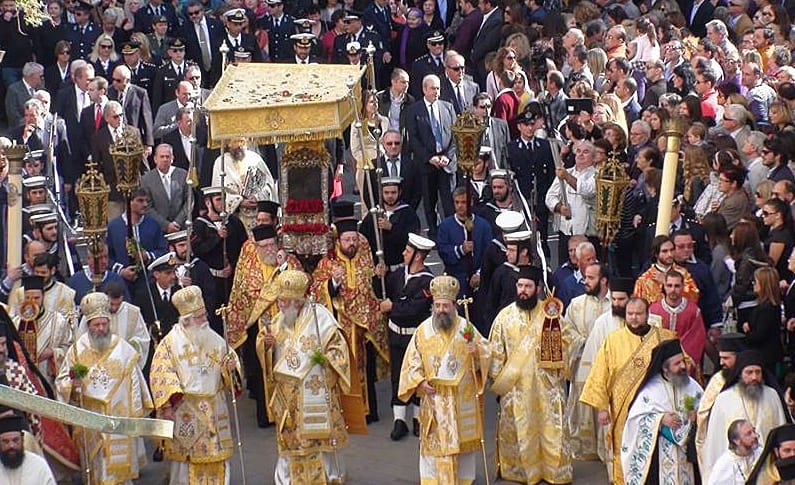
Corfu honors Saint Spyridon with four major annual processions, each linked to significant historical events. One of the most important is the Palm Sunday procession, the largest procession of the year, which commemorates the island’s deliverance from the plague in 1629. Another notable procession occurs on Holy Saturday, marking the salvation from the famine of 1553. This event is the climax of the Corfiot Easter celebrations and is accompanied by some of the most famous dirges and marches performed by the island’s philharmonic societies. Among these are “Calde Lacrime” by the Mandzaros Philharmonic Society, Beethoven’s “Heroic” march performed by the Kapodistrias Philharmonic Union, and the beloved “Amleto,” rendered by the Old Philharmonic Society of Corfu.
One of the most beautiful festivals of the year takes place in the heart of summer, on August 11th. Known to the locals as “Little Easter,” this day celebrates the expulsion of the Ottoman Turks from the island in 1716 following a siege. It remains a deeply significant occasion for the people of Corfu, full of both religious and historical meaning.
An often lesser-known but cherished tradition among Corfiots occurs on the first Sunday of November, known locally as “Protokyriako” or “First Sunday.” This procession commemorates the end of the plague in 1673 and is particularly beloved by the island’s residents, who gather to honor this moment of deliverance.
The principal feast day for Saint Spyridon is celebrated on December 12th with three days of religious ceremonies including prayers, vigils, and processions. During this period, the saint’s relics are displayed for public veneration, drawing crowds of believers from all over Greece who come to pay homage and seek blessings.
Today, Corfu continues to maintain its vibrant religious traditions. The churches and monasteries on the island serve as active centers of worship and culture. Religious festivals and processions continue to attract both locals and visitors alike, maintaining the spiritual fabric of the community. The presence of Saint Spyridon is felt in every corner of the island, with Corfiots honoring him not only as their protector but also as a symbol of their faith and unity.